Science Talk
This is a Pay What You Will event.
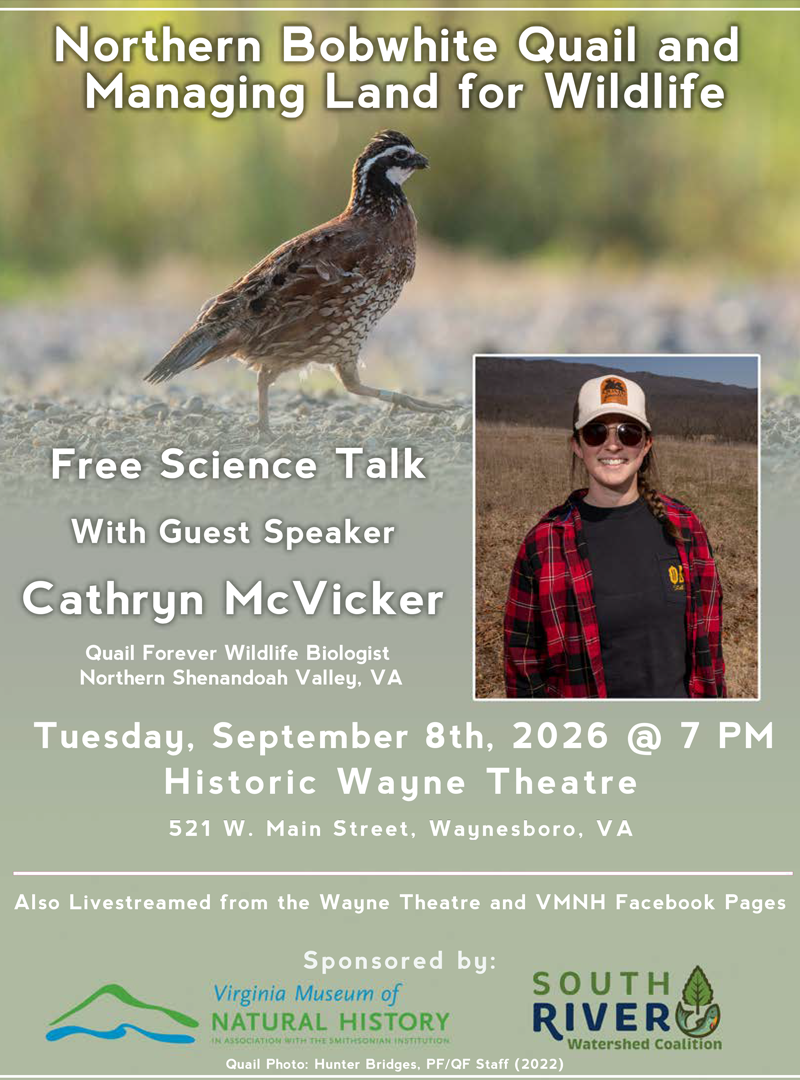
Northern Bobwhite Quail and Managing Land for Wildlife
Guest Speaker:
Caty McVicker, Quail Forever Biologist
Topic:
Since the 1960s, Northern bobwhite populations in Virginia have been in steep decline. Factors such as increasingly intensive agricultural operations, reduction of native habitat, transition of land use, and repression of natural ecological disturbances have majorly contributed to this decline. In order to help restore bobwhite populations and improve habitat, it is imperative to work alongside private landowners and farmers to ensure working landscapes are benefitting not only agricultural production, but wildlife, as well. This presentation will take you through the natural lifecycle and habitat requirements of northern bobwhite, and the ways that we can work to promote these ecosystems on private lands in Virginia. It will also address specific challenges that are faced concerning northern bobwhite and grassland bird conservation in general, and we will look at real applications of conservation Best Management Practices (BMPs) on working landscapes.
Speaker: Caty McVicker, Quail Forever Biologist:
Cathryn (Caty) McVicker received her Bachelor of Science in Biology and Conservation Studies from George Mason University in Fairfax, Virginia. She is currently pursuing her Master’s in Ecosystem Management and Administration from Pennsylvania State University. She became especially interested and passionate about bird and habitat conservation during her time with the Smithsonian’s National Zoo and Migratory Bird Center in Washington, D.C., and she has completed internships with local conservation organizations to learn more about best management practices and land use. Caty has been working as a Wildlife Biologist with Quail Forever since January 2024, and she currently services the Northern Shenandoah Valley. As part of her position, Caty also represents the Virginia Grassland Bird Initiative in the Valley, and she has gained years of experience interfacing directly with landowners on working landscapes to promote conservation Best Management Practices (BMPs).



.png)
.png)
.png)
.png)
